Teamfight Tactics — Riot Games’ auto-battler format built within the League of Legends ecosystem — incorporates several systems designed to regulate resource distribution across an eight-player competitive lobby. Among these, the carousel round functions as one of the most structurally distinctive mechanisms in the game. Unlike gold income, shop probability tables, or unit pool management, the carousel operates as a simultaneous selection event: all participants engage with the same resource pool at the same time, under conditions that are partially governed by match standing. The result is a hybrid distribution system that blends competitive access ordering with constrained randomness, producing outcomes that carry meaningful strategic weight across the full arc of a game session.
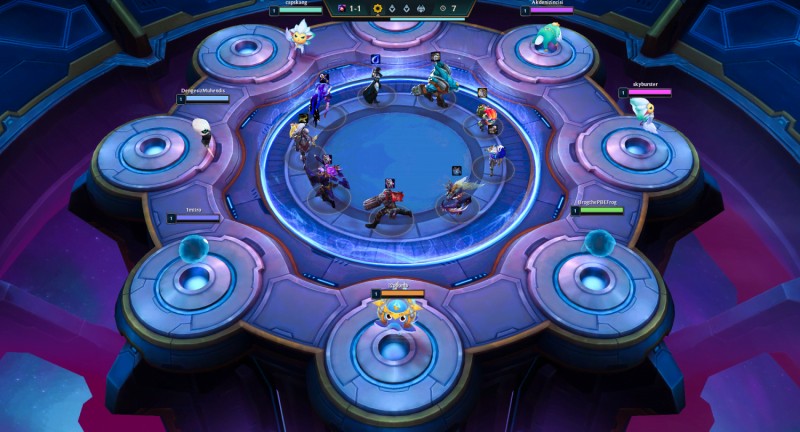
Core Concept of the Carousel Round
The carousel presents a rotating ring of champion units, each pre-attached to a single item component or completed item. Participants select one unit from this ring, acquiring both the champion and its associated item simultaneously. The selection order is not random — it is inverted relative to current health standing, meaning participants with lower health values gain earlier access to the available pool. This ordering principle serves a specific mechanical function: it introduces a partial correction mechanism against runaway performance, granting underperforming participants preferential access to resources without fully neutralizing the performance gap.
The item attached to each carousel unit is generated through a combination of set-defined parameters and randomized distribution logic. Not all item components carry equivalent value across all game states, and the random composition of any given carousel creates variance in how effectively participants can convert their selection into board-relevant equipment. This variance is intentional — it prevents the carousel from functioning as a pure catch-up mechanism and preserves uncertainty in how the resource event will affect relative standing across the lobby.
How the System Appears Across Game Phases
Carousel rounds appear at fixed intervals within TFT’s stage structure. A shared carousel occurs at the conclusion of stage one and recurs periodically throughout the mid and late game, with a “PVE carousel” variant sometimes appearing after player-versus-environment combat rounds in certain set configurations. The stage-one carousel is categorically distinct from later instances: all participants gain simultaneous access rather than ordered access, and the item components available at this juncture are weighted toward foundational components rather than completed items. This functions as a lobby-wide resource equalization event at game start, establishing a baseline component floor before competitive differentiation accelerates.
Mid-game carousels introduce the health-based ordering system in full. The precise interval at which participants may enter the selection ring is staggered in seconds, and even small timing gaps between the lowest-health and highest-health participants can determine whether a contested unit-item combination remains available. In lobbies where multiple participants are targeting overlapping item builds, the carousel becomes a contested resource event with direct implications for board trajectory. The structural tension here is not incidental — it is a designed property of the distribution model, ensuring that carousel rounds carry decision relevance rather than functioning as passive resource grants.
Industry Applications Within the TFT Axis
Within TFT’s competitive framework, carousel mechanics intersect with several higher-order system considerations. Item component prioritization during carousel selection is directly linked to the flexibility or rigidity of a participant’s current board composition. A participant committed to a specific unit-trait configuration may deprioritize a statistically strong item component if it does not integrate with the intended build path, accepting a suboptimal carousel outcome in exchange for compositional coherence. Conversely, a participant operating in a flexible or “open” board state may select based purely on item value, deferring unit-composition decisions until shop offerings clarify available directions.
The carousel also interacts with the unit pool system in ways that are sometimes underappreciated analytically. Selecting a carousel unit removes that champion from the shared unit pool accessible through the shop interface. In lobbies where a particular champion is contested — meaning multiple participants require it for three-star upgrades or trait activation — carousel selection of that unit carries pool-impact consequences beyond its item value. This dual-resource property, where a single selection affects both item acquisition and unit pool availability, gives carousel rounds a compounded strategic weight that extends well past the immediate acquisition event.
Set-specific modifications have altered carousel parameters across TFT’s release history. Certain sets have introduced augment-modified carousel access, variable item distributions skewed toward specific component types, or carousel configurations offering completed items rather than components. Riot Games has used these variations to adjust the carousel’s function as a catch-up mechanism, in some configurations amplifying its corrective effect and in others flattening it to reduce late-game variance.
Conclusion
The carousel round in Teamfight Tactics is best understood not as a standalone feature but as a distribution subsystem embedded within a larger resource management architecture. Its ordering logic, item composition parameters, and interaction with unit pool availability collectively determine how effectively the mechanism regulates performance variance across a game session. The system’s design reflects a deliberate balance between corrective access ordering and preserved randomness — structured enough to prevent complete runaway outcomes, variable enough to ensure that carousel results remain consequential rather than predetermined. As TFT’s set framework continues to evolve, the carousel’s specific implementation will shift, but its structural function as a contested simultaneous resource event appears to be a stable design commitment within the format.