Core Design Framework of Champion Traits in TFT

Within the architecture of Teamfight Tactics (TFT), champion traits form one of the central structural mechanisms that govern systemic interactions between units on the battlefield. Rather than functioning merely as descriptive labels, traits operate as programmable rule modules embedded in each champion entity. When activated through specific combinations, these modules introduce additional behaviors, statistical modifications, […]
Structural Architecture of the TFT Auto-Battler System
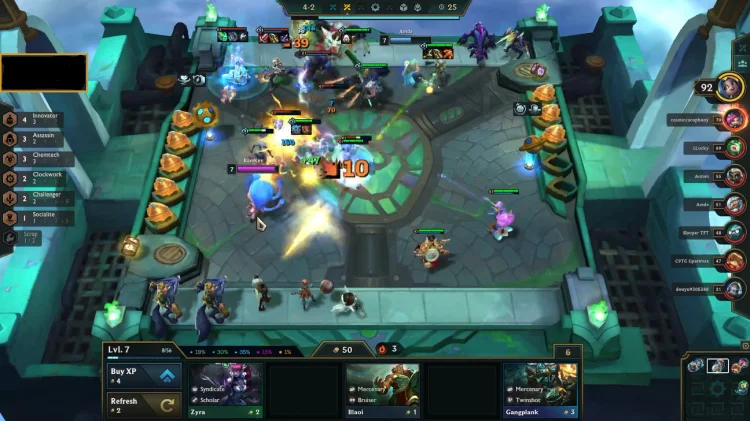
The auto-battler genre represents a specialized branch of digital strategy design in which tactical preparation replaces direct unit control during combat. Within this genre, Teamfight Tactics (TFT) demonstrates a layered architecture that integrates board positioning, probabilistic unit acquisition, and automated battle resolution. The structural design of TFT differs from conventional strategy systems by separating planning […]
When high-cost champion hunting becomes statistically inefficient in Teamfight Tactics
In Teamfight Tactics, late-game compositions centered on four-cost and five-cost champions rely on a narrow probability window defined by shop odds, shared champion pools, and simultaneous demand from multiple players. Within this system, “high-cost champion hunting” refers to rolling primarily to locate specific high-tier units as the core of a composition, most commonly after reaching […]
Reroll strategies in TFT and champion pool depletion dynamics
Reroll strategies in Teamfight Tactics represent a constrained optimization problem built around fixed champion pools, level-dependent shop probabilities, and timing windows where low- and mid-cost units can realistically reach three-star thresholds. Within this system, rerolling is not defined by mechanical repetition of shop refreshes, but by interaction with a finite shared resource: the global champion […]
How roll depth affects expected board upgrade value in Teamfight Tactics
In Teamfight Tactics, roll depth refers to the total number of shop refreshes committed during a single stabilization window. Its strategic relevance lies in how each additional roll changes the expected board upgrade value, defined as the probability-weighted improvement of functional strength, trait activation, and unit quality that can be realized from the shop. Roll […]
TFT shop probability distributions and their impact on rolling decisions
In Teamfight Tactics, shop outcomes are generated through a layered probability system that combines level-dependent cost distributions with finite champion pools. These two mechanisms define the statistical structure governing every refresh of the shop and, by extension, all rolling decisions. Rather than representing a simple random draw, each shop slot is produced through a controlled […]
Gold efficiency differences between reroll and fast-8 strategies in Teamfight Tactics
In Teamfight Tactics (TFT), gold efficiency is defined by how effectively gold is converted into board strength through the game’s probability system, leveling structure, and shared champion pool. Two dominant spending models—reroll and fast-8—illustrate fundamentally different efficiency profiles. Although both strategies rely on the same income rules, interest thresholds, and shop mechanics, they allocate gold […]
How early carousel outcomes affect gold planning in TFT
In Teamfight Tactics, the early carousel is commonly framed as an item acquisition phase. However, from a systems perspective, the carousel also introduces discrete and often overlooked variations in early‐game gold availability. These variations emerge from the unit attached to each carousel item, the sell value of that unit, and the ordering rules that determine […]
When breaking economy is mathematically justified in TFT matches
Within Teamfight Tactics (TFT), the concept of “breaking economy” refers to spending below interest thresholds or abandoning long-term gold optimization in order to alter short-term board strength and future outcome distributions. This article treats the question strictly as a systems problem: under which quantitative conditions does sacrificing gold efficiency produce a higher expected placement than […]
Loss-streak versus win-streak: economic trade-offs in TFT
In Teamfight Tactics, streak mechanics operate as a secondary economic system layered on top of base gold income and interest thresholds. Win-streaks and loss-streaks do not merely redistribute short-term rewards; they modify how gold accumulation, health preservation, leveling access, and shop interaction evolve across early and mid stages. In this economic trade-off, the relevant comparison […]